
Wayne County Court Docket Searches
Start with Utah Courts Xchange, the main public search for Wayne County court records. Choose District Court for civil, domestic, probate, felony, and Class A misdemeanor cases. Choose Justice Court for traffic, infractions, and ordinances. It also handles most Class B or C misdemeanors and small claims. Unsure which level holds the file? Search both.
Search with the strongest detail you have. A case or citation number works best. Pair it with Wayne County or a court name, because those numbers are not unique statewide. A name search lets you narrow by case type, location, and date. Xchange may charge per search, so set the scope before you begin.
- Choose District, Justice, or both, then set Wayne County or the known court.
- Enter a case number, citation number, or party name. Use the first-name wildcard for spelling variants.
- Narrow broad results with case type and the right filing, disposition, judgment, or satisfaction date.
- Open Case History to review public events, counsel, hearings, and disposition terms.
- Confirm future activity in Court Calendars, then ask the clerk for a copy or certified record.
Wayne County Xchange Fields
Court level, scope, and date type each shape what a search returns, and the official Xchange help page spells out why. A result list of 500 entries means you hit the cap, not that only 500 cases exist. Tighten the court, the case type, or the date range and try again.
| Field | Use | Local caution |
|---|---|---|
| Jurisdiction | District, Justice, or both | Select the level that owns the case |
| Case or citation | Direct identifier | Add location |
| Name or company | Party search | Try variants and wildcard |
| Scope | State, county, or court | Wayne narrows stray hits |
| Date category | Four event types | Choose the event researched |
The official Xchange search shows the full starting screen.
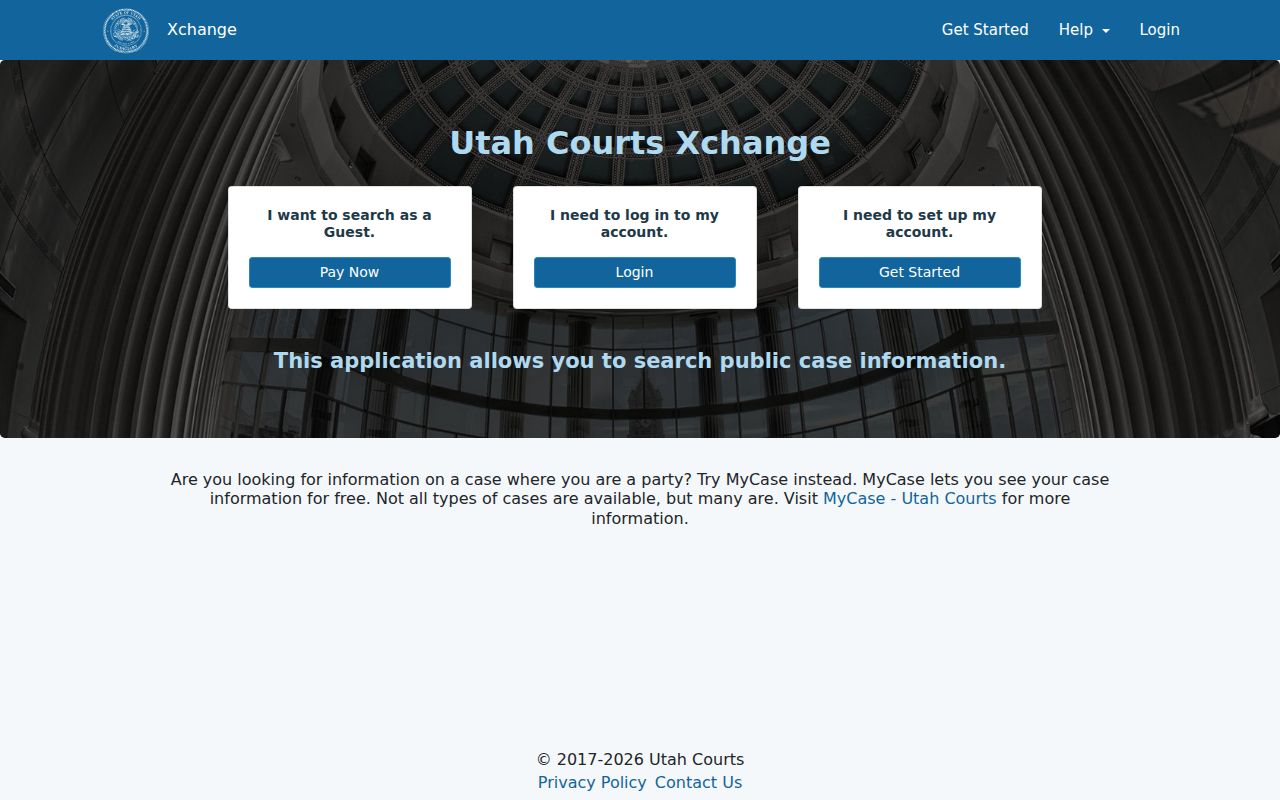
Court, name, number, case type, and date filters all work together as a single docket search workflow.
Court Dockets: What They Show
Utah Xchange labels its register-of-actions-style view a Case History or extended case history. Think of it as the chronological index to a Wayne County court file. It is not always the file itself. Public entries can show the court, case type, and filing date. They also list party roles, attorneys, and proceedings. Future hearings, judgments, and disposition appear too. Some district matters also offer document images for purchase.
| Case number | A court identifier that should be paired with location. |
|---|---|
| Case type | The civil, criminal, probate, traffic, or other category. |
| Parties and counsel | Public role codes and attorneys, subject to access limits. |
| Proceedings | Motions, minutes, pleas, orders, and dated case events. |
| Hearings | Activity that should be checked again in Court Calendars. |
| Disposition | The recorded result or status. |
The underlying documents are separate records. A complaint, exhibit, signed order, transcript, and audio recording each may need a purchase link or a clerk request.
Wayne County Case History Terms
A one-word label rarely tells the whole story. Wayne County docket entries gain their meaning from the order they appear in, and the Utah case-type list is a good starting point for decoding them.
- Case History
- Xchange's chronological public view of recorded events.
- Setting
- A scheduled event, not a promise that trial occurs that day.
- Continuance
- An order moving an event; it does not dismiss the case.
- Disposition
- The recorded outcome of a charge, claim, or stage.
- Judgment
- A formal result, distinct from later satisfaction.
Read each date with its label. A filing date, a hearing date, and a judgment-entry date mark different events in the Wayne County docket.
Wayne County Courts and Their Dockets
Wayne County sits in Utah's Sixth Judicial District. The District Court holds general jurisdiction, the Justice Court holds limited territorial jurisdiction, and juvenile matters use a confidential route.
| Court | Docket covers | Search |
|---|---|---|
| Sixth District, Wayne | Civil, domestic, probate, felony, Class A misdemeanor, Justice appeals | Xchange and 2807D |
| Wayne Justice | Traffic, infractions, ordinances, B/C misdemeanors, small claims | Xchange and 2807J |
| Juvenile Court | Delinquency and child welfare | Confidential route |
| Utah appellate courts | Allowed appeals | Appellate resources |
A Justice Court appeal goes to District Court. There it gets a fresh hearing or trial. Most district and juvenile appeals route to the Utah Court of Appeals, while set categories go to the Utah Supreme Court.
Two Wayne County Calendar Codes
The Utah Court Calendars splits Loa District from Wayne County Justice Court. Loa District carries code 2807D. Wayne County Justice Court carries code 2807J. Pick the wrong one. You may see an empty screen even though an open setting exists in the other. The location code beats a town name. The calendar offers no separate court location for each incorporated Wayne County town.
Sort results by judge, case name, or date and time. A public event may be in person, hybrid, or virtual. If no remote link appears, call the court. Public access does not permit recording, photographing, or transmitting proceedings. Remember that a calendar is a rolling schedule, not a full archive. Save the court, date, event type, and mode. Then confirm any later change through the live Wayne County court calendar.
Court Dates and Settings in Wayne County
Trust the calendar over an old notice or a single Case History entry. Utah updates calendars on weekdays at about 5:30 a.m. A judge can still reset or cancel an event. Search by location and date, case number, party, judge, attorney, or bar number.
The safest chain is the online calendar first. Then get clerk confirmation. For 2807D, call District Court at 435-836-1301; for 2807J, call the Justice clerk at 435-836-1321. You can also inquire at 18 South Main in Loa. Or send a written request for historic event records. The Wayne County court schedule covers resets and missed settings.
When Wayne County Searches Fail
A blank result does not prove no case exists. Check the court level, the Wayne scope, spelling, and the date category. Loa District CORIS coverage starts February 24, 2000, so older material may be sparse online. Private and sealed files can stay out of results. So can expunged, juvenile, adoption, child-welfare, and protected domestic files.
Next step: Ask the proper clerk whether the record is public, maintained, on a free terminal, or available by written request.
When a document is missing, open the extended history and look for a purchase marker. If none appears, request the document, recording, or transcript rather than treating the entry as the complete file.
Docket Access Under Utah Law
Utah court rules govern judicial records. Public access is broad for public records. Still, classifications protect private, safeguarded, sealed, and juvenile material, and a clerk reviews and redacts protected content when required.
Key Utah court rules:
Rule 4-202.02 classifies public and nonpublic records.
Rule 4-202.04 sets request content and review.
Rule 4-202.06 generally gives ten business days, or five for a qualifying expedited request.
Rule 4-202.08 governs record fees.
If access is denied, you can appeal in writing within 30 days. Viewing a case history still does not open every filed item to you.
Wayne County Access Channels
Paid Xchange is only one route. Utah Courts reports free CORIS or Xchange access at most district courthouses and some Justice Courts, so confirm the Wayne terminal and its hours before travel. A terminal does not bypass access restrictions. The guest registration screen on the Utah Courts site lays out a 24-hour window and a 30-minute idle timeout.
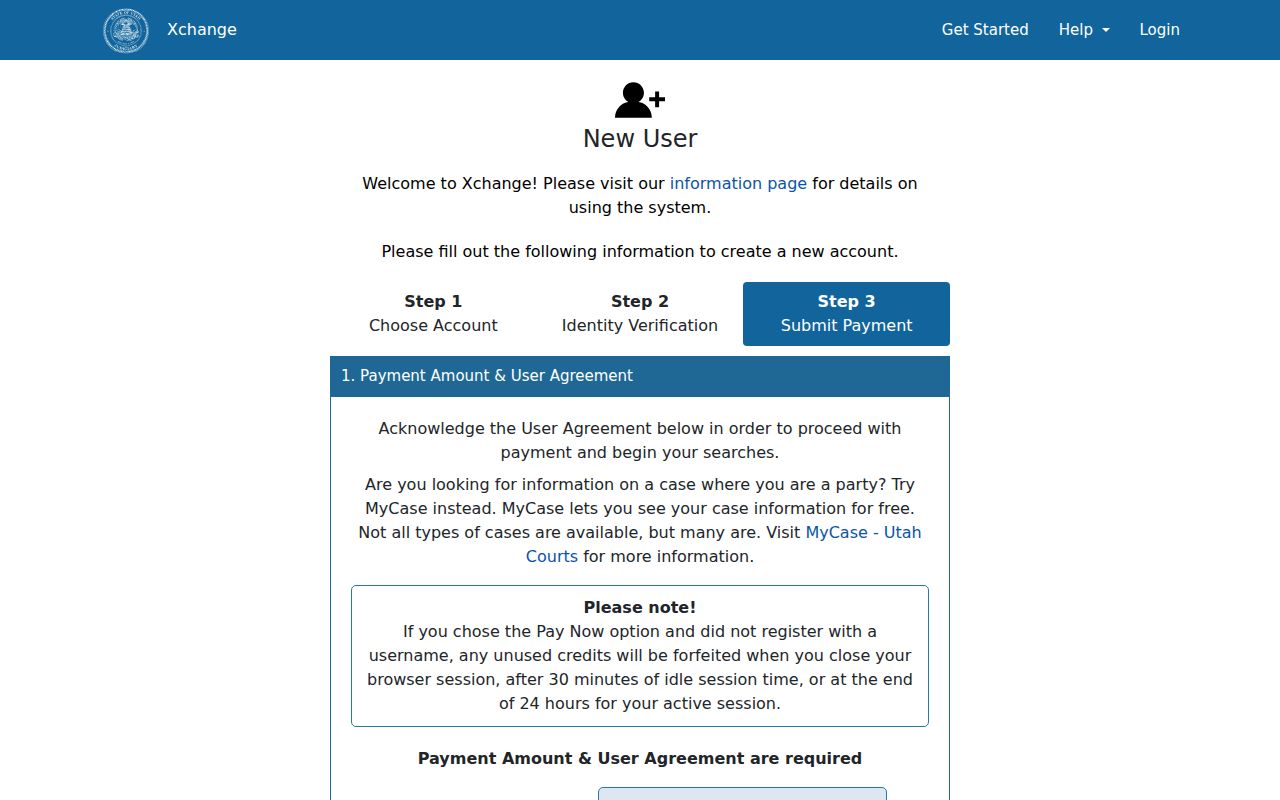
Gather your identifiers before a paid guest session starts. Other channels are the counter, phone routing, mail, and the official court-record form. MyCourtCase gives parties free access to linked cases, but it is not a general public search.
How the Clerk Keeps Docket Records
Deputy Clerk Kassidee Brown routes district files. Justice Clerk Jakelle Pace handles traffic, ordinance, limited criminal, and small-claims matters. County Clerk/Auditor Felicia Snow handles county government and is not a substitute for either court clerk.
Count on weekdays from 8:00 a.m. to 5:00 p.m., with a lunch closure from 12:30 to 1:00. The justice clerk keeps different hours, 9:00 a.m. to 5:00 p.m., per local listings. Call ahead before making the trip for docket help.
Wayne County Copy Costs
What a copy costs depends on how you order it. Check the current Utah fee schedule and Rule 4-202.08, since staff time, media, delivery, or redaction can push the total higher.
| Item | Researched amount |
|---|---|
| Paper | $0.25 per sheet |
| Certified copy | $4 plus $0.50 per page |
| Exemplified copy | $6 plus $0.50 per page |
| Audio | $15 per half day |
| FTR Cloud | $10 per recording |
| Xchange one-time | $10 initial, $0.35 per search, $1 per document |
The plan page distinguishes access options.
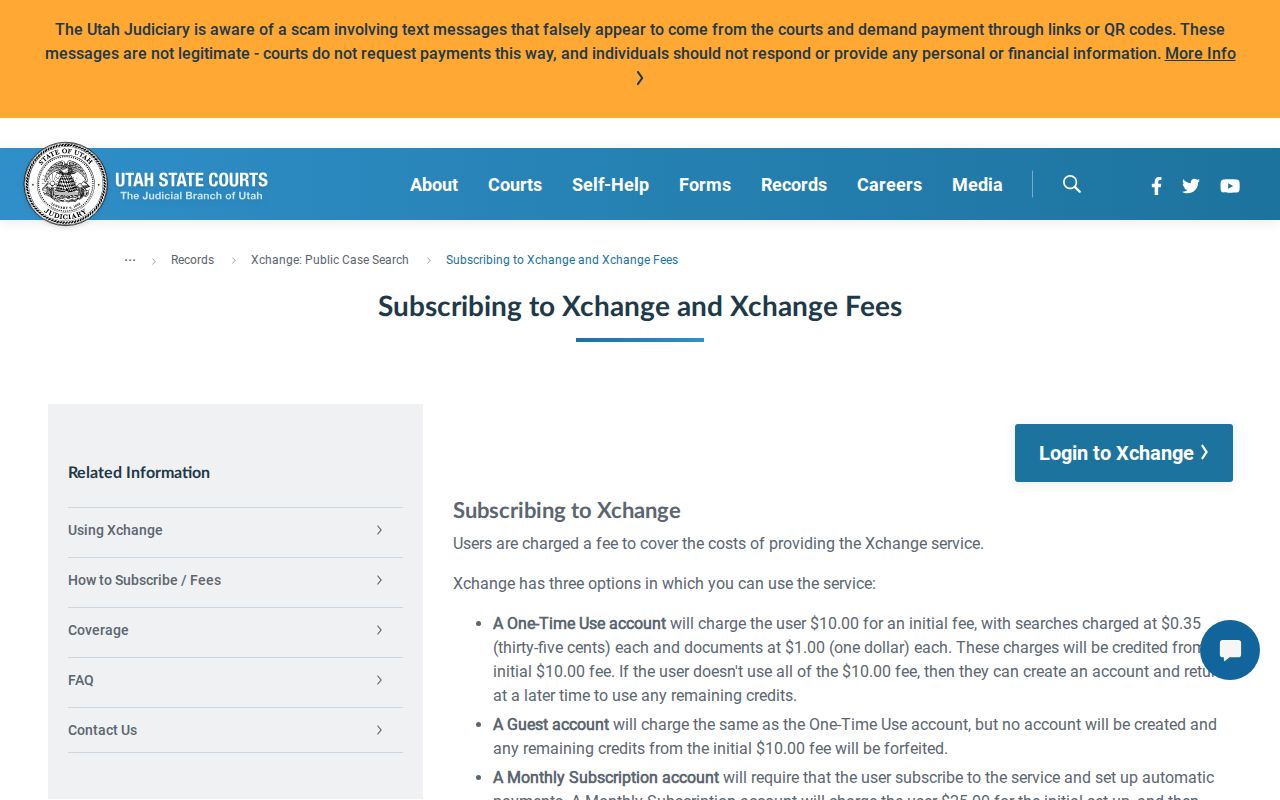
The official display separates one-time, guest, and monthly plans.
Wayne County Paper-Era Records
Paper-era coverage has a hard start date. The coverage table gives February 24, 2000 as the Loa conversion date. Wayne County filings before then may show thin fields or sit entirely offline. No clever search terms will close that gap. Even a converted case can leave some paper-era events and images out of public view. That conversion date is therefore the first thing to weigh whenever a docket search comes back empty.
For older court records, give the district clerk detail. Name the court level and a rough year. Add the case type, the names on the filing, and any case number. Genealogy and history projects sometimes lead out of the courthouse and into archives. State court record resources also help. They separate current case material from archival holdings, appellate dockets, and court recordings. Keep the request narrow. Name the Wayne County court, a reasonable span of years, and the exact record you want. That gives staff enough to place the item. It may live in CORIS, a paper file, an archive, or some other custody channel.
One trap deserves a warning. Richfield converted in 1995. That date has nothing to do with Wayne County just because both seats sit in the Sixth District. A Richfield result is a Wayne County case only if the court and location fields say so. District geography is about administration. The docket's own court location field tells you where the file actually belongs.
Official Fields in Wayne County
The official instructions identify the public search and Case History fields.
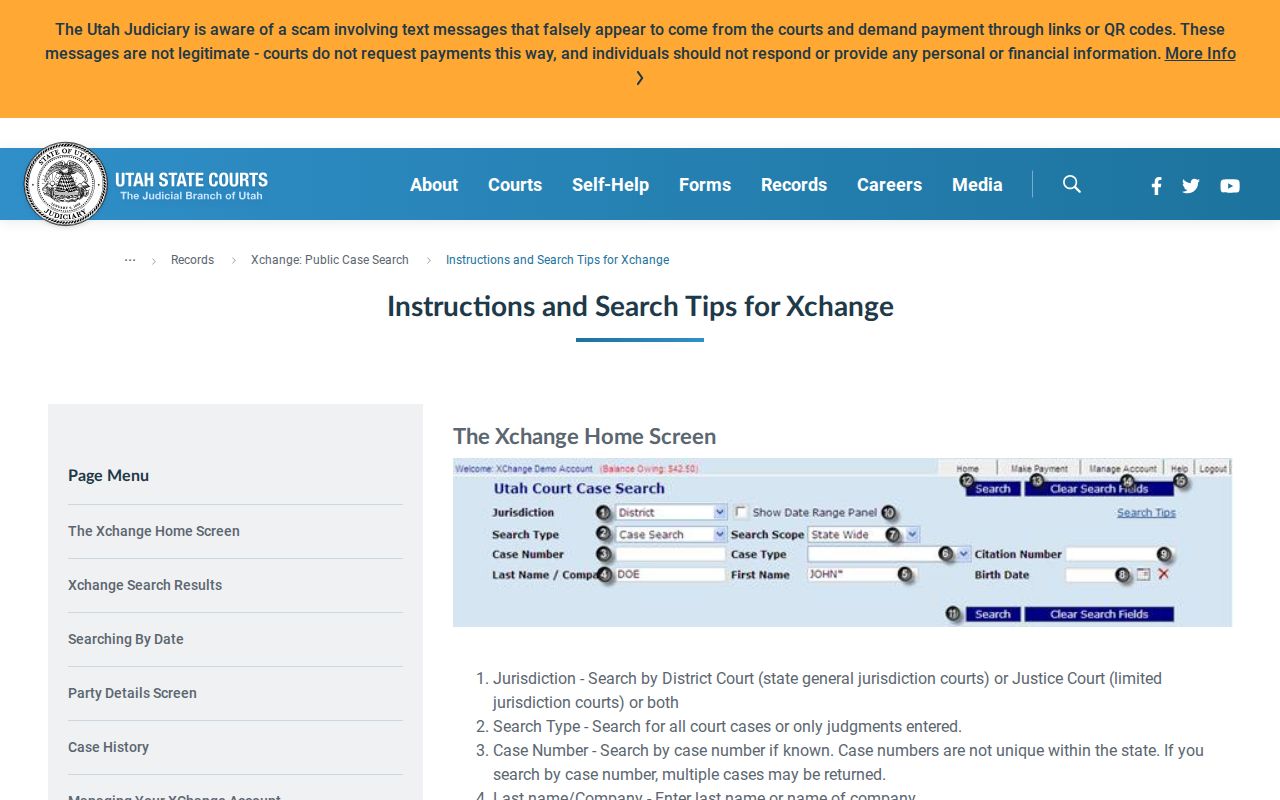
Every label on a Wayne County docket entry needs context. Party codes mark a person's role. Case-type codes classify the filing, and a judgment or disposition code marks a recorded outcome. Read each one against the dated entries around it, never alone. Birth dates, private addresses, protected details, and juvenile data are sensitive. They should never be copied into public examples.
When a code stumps you, compare it with the official Utah code lists. You can also ask for the underlying public order. Court staff can walk you through the record route. They can confirm whether an item is available. They cannot, however, give legal advice about what an order means for your case.
City-by-City Court Dockets in Wayne County
The 2020 Census counts five incorporated towns in Wayne County. None of them runs its own town court calendar. Town agendas are municipal records, not judicial dockets. Any court docket search starts with Wayne Justice or Loa District. The distinction matters. A town notice about zoning, water, roads, a budget, or a public hearing records local government action, and it joins a judicial court history only if a separate case is filed and gets a court number.
Loa Court Records
572 residents. County seat and courthouse route.
Bicknell Court Records
323 residents. County court routing applies.
Torrey Court Records
231 residents. Town and court records differ.
Lyman Court Records
196 residents. Court route leads to Loa.
Hanksville Court Records
158 residents. Confirm dates before travel.
Each town page holds that line. It traces a local routing trail. For a citation, an ordinance allegation, or a small claim, use one starting point. Begin with Wayne County Justice Court. District civil, domestic, probate, felony, and Class A misdemeanor matters are different. They belong at the Loa District location. Town staff can answer questions about their own notices and administrative files. They should not get a court-record request simply because an event happened inside town limits.
The lack of a city calendar is practical, not legal. Nothing here claims Utah law bars town courts. Check recent changes with the town and the Justice Court. Wayne County's shared route can shift. The live citation or court notice always controls.
Map and Directions to the Wayne County Courthouse
Sixth District Court files for Wayne County civil, domestic, probate, felony, and Class A misdemeanor cases are kept at the Wayne County Courthouse, 18 South Main in Loa. The Wayne County Justice Court, which handles traffic, infractions, ordinances, most Class B/C misdemeanors, and small claims, sits in the same building but keeps its own mailing address and clerk line. The courthouse also houses the county clerk, recorder/treasurer, assessor, extension, health, and sheriff offices, so it is a multi-office county building rather than a court-only campus.
Wayne Justice Clerk
PO Box 327
Loa, UT 84747
435-836-1321
County office hours are weekdays, 8:00 a.m. to 5:00 p.m., with a 12:30 to 1:00 lunch closure, though the Justice clerk is separately listed from 9:00 a.m. to 5:00 p.m. The official location page does not publish a parking map or entrance/security description for this courthouse, so calling ahead is the safer plan.